When exporting building products to the European Union, Chinese suppliers must navigate a framework of mandatory and emerging requirements. These rules exist to ensure product safety, performance consistency, and environmental responsibility. Non-compliance can result in rejected shipments, fines, or loss of market access.
| CE Marking | A mandatory product passport for the EU market. | Proves a product meets all applicable EU health, safety, and environmental legislation. It is affixed to the product itself. |
| DOP (Declaration of Performance) | A legally binding technical document accompanying a CE-marked product. | Details the product's declared performance against its harmonized European standard (e.g., EN 1090). The manufacturer is fully responsible for the information. |
| CBAM (Carbon Border Adjustment Mechanism) | An emerging environmental regulation on embedded carbon emissions. | Puts a carbon price on imports of certain goods (initially iron/steel, aluminum, etc.) to prevent "carbon leakage." Requires reporting and eventual purchase of certificates. |
| DOC (Declaration of Conformity) | A statement confirming the product meets all relevant EU directives (often broader than construction). | Declares the product's conformity with applicable EU laws. It is more general than a DOP. A DOP is the specific type of DOC required for construction products under the CPR. |
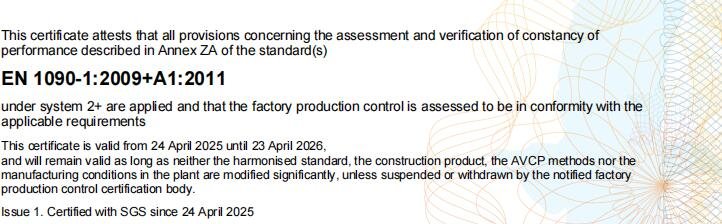
| EN 1090 | A harmonized technical standard for fabricated steel and aluminum structures. | Specifies requirements for materials, fabrication processes, and Factory Production Control (FPC). It is the basis for CE marking for structural metal components. |